Before sanding: measure moisture, lift the old floor, fill
A wood floor laid on a subfloor that is too damp or badly prepared has to be redone, and redoing it costs more than laying it. Here is what the catalogue offers for each step of this phase.
7 min read - published on
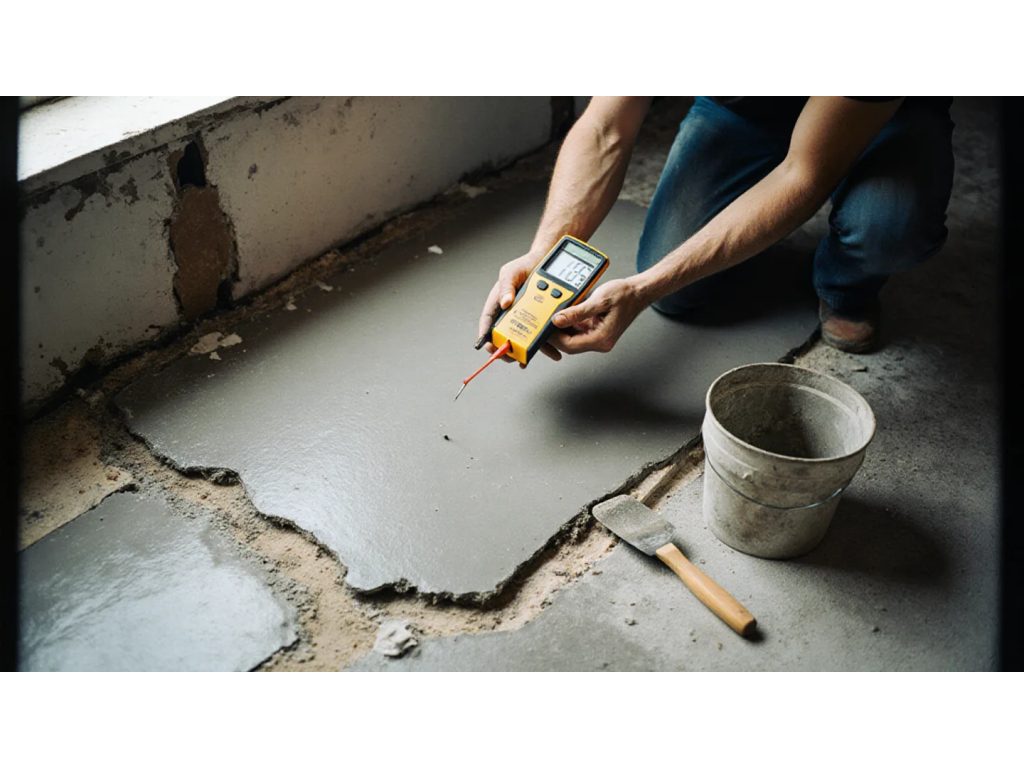
Measure, then decide
Moisture is the leading cause of problems on a new wood floor. It is measured, with an instrument, before the wood is ordered. The SIMA catalogue stocks six instruments, and they do not measure the same thing.
| Instrument | Reference | What it measures | Stated range |
|---|---|---|---|
| COMPACT hygrometer | 112010 | moisture in wood and plasters, electronically | 5 to 20 % for wood, 0.3 to 3.5 % for plasters |
| COMPACT B hygrometer | 112030 | preliminary test by simple contact | 0 to 100 digits |
| COMPACT F2 hygrometer | 309800 | air humidity and room temperature | 0 to 100 % to one decimal place, -20 to +80 degrees to the nearest degree |
| Moisture tester | 114400 | wood, concrete and materials, by simple contact | measuring depth of about 50 mm |
| Hygromat CM-B | 002910 | moisture in screeds, concrete slabs and similar, using calcium carbide | direct measurement on the floor |
Two approaches complement each other. Contact instruments give an immediate, non-destructive reading: that is the role of the COMPACT B, whose sheet states explicitly that it serves as a preliminary check before getting out the CM-B.
The calcium carbide measurement is the other approach. A sample of the subfloor is taken and made to react in a pressure vessel with a carbide ampoule; the pressure produced gives the moisture content. The catalogue sells the consumables: box of 20 calcium ampoules (ref. 003620) and box of 10 water ampoules (ref. 003626).
Finally, the COMPACT F2 does not measure the subfloor but the room conditions. Its sheet carries the statement “essential before any floor finishing”.
Lifting what is already there
The catalogue stocks a complete range of floor strippers, from the hand-held machine to the self-propelled one.
| Machine | Reference | What its sheet claims |
|---|---|---|
| Junior stripper | 104640 | light and manoeuvrable, carpets and floor and wall coverings, hard-to-reach places, recesses, under radiators, stairs |
| Duro stripper | 104950 | old carpet, remains of foam underlay and flexible coverings, small and medium areas, used standing up thanks to the handle and wheels |
| Floor stripper | 194400 | machine with interchangeable blades, with a U blade for pre-cutting and lifting PVC and linoleum, and a blade for rigid PVC tiles, ceramic tiles and glued mosaic wood floors |
| Turbo stripper with automatic feed | 104800 | any glued covering, including polyurethane and epoxy adhesives, studded rubber floors, sports floors, 2 600 W motor, self-propelled, handle adjustable to 8 positions |
The Floor stripper names two blades by their reference in its own sheet: the U blade has the reference 128050 and the blade for rigid tiles the reference 128155. Replacement blades for all four machines are in the catalogue under separate sheets.
For adhesives that resist, two complementary routes.
Steam. The EMILIO steam generator (ref. 220140) is an automatically refilling generator combined with a wet and dry vacuum cleaner, rated at 165 degrees. The catalogue also stocks two steam generators classed as stripping machines, the Master (ref. 120290) and the Turbo (ref. 120160), with heat-up times stated on the sheets: 16 minutes from cold water and 5 minutes from hot water for the Master, 25 and 8 minutes for the Turbo. The Master takes a maximum weight of 130 kg on its step.
The disc. On a single disc machine, the titan disc (ref. 043423) is given for fast removal of levelling compounds, hard adhesive residues, old carpet residues and resins. The scrapper disc (ref. 043425) targets hard adhesives. The 406 mm backing pad with carbide pin ring (ref. 043400) removes resins, adhesive residues, levelling compounds and cement screeds. On Trial and Quadral, the Ø 140 mm diamond skrapper (ref. 000681) and the triple diamond skrapper (ref. 000686) do the same job.
For a concrete floor that needs serious rework, the floor planer (ref. 776200) planes, mills, strips and surfaces. Its sheet states a depth of 3 mm per pass on concrete, adjusted with the handwheel.
Scraping
Three hand tools in the catalogue: the floor layer's scraper with wooden handle and slightly curved blade, the Stanley scraper with interchangeable blade, two cutting edges, hardened steel, and the replacement scraper blades. The joint cleaner (ref. 686655) is a claw that cleans the joints between boards, with a built-in bottle opener. The wood floor lifter (ref. 487555) is a board lifter with a telescopic lever arm from 55 to 94 cm, given for a force of 900 kg.
Filling and stopping
Four products, four logics.
Losung MS 31 (ref. 514000) is a liquid binder to be mixed with sanding dust, for filling joints and cracks in wood floors and joinery. Its sheet stresses one point: the mix takes the colour of the wood, since it is the wood from the job that provides the filler. The matching thinner is MS 50 (ref. 514001). The catalogue stocks a second product working on the same principle under the name Mastic à bois.
Bois parket poudre is a powder filler to be mixed with water, made from animal and vegetable glues, solvent-free, non-toxic and non-flammable. It fills holes and cracks and allows wood floors to be surfaced. Available in light oak, medium oak, dark oak and pine.
Sintobois is a two-component wood filler of high hardness that can be sanded, screwed, stained and painted. Its sheet claims fast drying in 20 minutes and no shrinkage. Available in pine, light oak, medium oak and mahogany. The figure of 20 minutes comes from the text carried over from the old site and needs confirmation.
Heavy-duty stripper, ready to use and sprayable, no rinsing required, suitable for stripping varnishes, wood stains, adhesives, alkyd and acrylic paints.
For applying fillers in cartridges, the pro rotating cartridge gun (ref. 511325) has a rotating function that lets you work in corners without repositioning the nozzle.
Bonding the new floor
The adhesive in the catalogue is Bostik HPA 180, and its sheet is one of the best documented on the site. What it claims:
- single-component polymer-based adhesive, moisture resistant, fast grab, no flash-off time;
- water-free, so no risk of the wood warping; solvent-free and isocyanate-free for the floor layer;
- rated A+ for volatile organic compound emissions;
- compatible with underfloor heating, electric radiant floors and reversible heating and cooling floors;
- permanent elasticity, returning to its initial elastomeric properties after compression or elongation;
- for solid wood floors up to 180 mm wide and 23 mm thick;
- direct laying without primer on concrete, wood, metals, ceramic tiles and anhydrite screed.
These characteristics come from the manufacturer's sheet carried over into the catalogue. The last two, in particular laying without primer, need confirmation before being presented as a commitment.
The laying range is completed by the notched adhesive trowel (ref. 007601), the stainless steel guided cutter, 18 mm blade (ref. 482320) with thumbwheel blade lock and steel blade carriage, replacement blades in dispensers of 10 (ref. 211718), and the masking roll in smooth masking paper with natural rubber adhesive for residue-free taping.
Dust and noise
Preparation is the dirtiest stage of the whole job. The catalogue stocks the corresponding protective equipment.
- FFP2 dust masks (ref. 488122), for fine and toxic dust, moulded cup mask with nose seal and anti-condensation valve, compliant with standard EN 149 / 2001.
- Dust mask (ref. 488111), for coarse non-toxic dust, disposable, compliant with EN 149 / 2001.
- Ear defenders, compliant with EN 352-1, with attenuation ratings of 28, 31 and 35 dB.
- Earplugs in polymer foam, rating 28 dB.
- Knee pads (ref. 030032), washable and waterproof, neoprene and hook and loop fastening.
- Protective overshoes and latex gloves (ref. 031893).
For dust extraction, the Mistral 20 (ref. 429020) and Mistral 50 (ref. 429050) extractors, the 3-motor industrial vacuum cleaner (ref. 429000) and the Festool CTL range complete the set-up.
What this guide does not say
It does not say at what moisture content a subfloor is considered fit to receive a wood floor. This threshold depends on the subfloor, the type of installation and the wood species, it engages the responsibility of the person laying the floor, and it has no place in a text that has not been validated. Ask the question on 03 87 71 37 50 or describe your job in the form: the answer arrives within 24 working hours.