Which abrasive grit to sand a wood floor
The grit is only a number. What decides the result is also the abrasive material, the backing, and the format your machine takes. Here is what the catalogue actually contains.
5 min read - published on
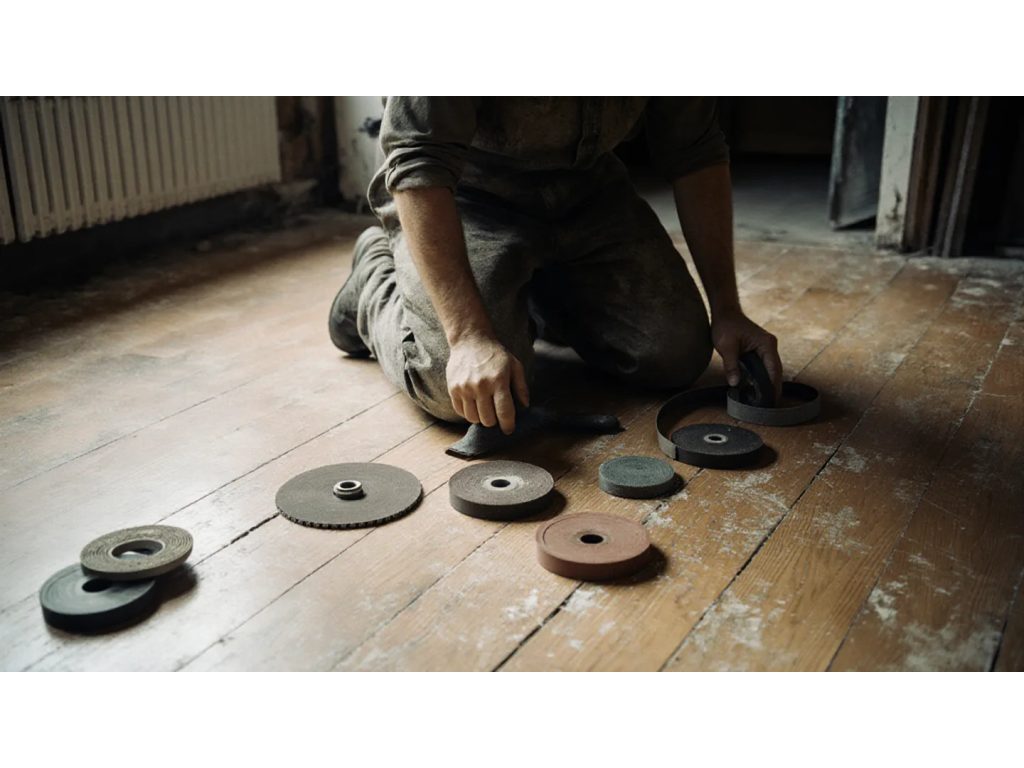
What the grit number means
The smaller the number, the more aggressive the abrasive. A grit 16 bites, a grit 320 caresses. Between the two, the SIMA catalogue offers fourteen values: 14, 16, 24, 36, 40, 50, 60, 80, 100, 120, 150, 180, 220 and 320. Not all of them are available in every format, and it is the format that decides, because it depends on the machine you have at hand.
Four abrasive materials, four behaviours
The catalogue distinguishes four materials. The distinction is made by the product sheets themselves, and it is visible on a single format, the 200 x 750 mm abrasive belt, where all four coexist.
| Material | Format where it is found in 200 x 750 | Grits available | Reference prefix |
|---|---|---|---|
| Aluminium oxide | Belt 200 x 750, heavy cloth backing, zig-zag joint | 16, 24, 36, 40, 50, 60, 80, 100, 120 | 750 |
| Silicon carbide | Belt 200 x 750, heavy cloth backing, zig-zag joint | 24, 36, 40, 50, 60, 80, 100, 120 | 751 |
| Zirconia | Belt 200 x 750, heavy cloth backing, zig-zag joint | 16, 24, 36, 40, 50, 60, 80, 100, 120 | 752 |
| Ceramic | Belt 200 x 750, heavy cloth backing, zig-zag joint | 36, 50, 80 | 753 |
The 200 x 480 mm belt is aluminium oxide. The 250 x 750 mm belt and the 203 x 475 mm sheet known as “HIRETECH RENT” are silicon carbide. Belts for portable sanders are aluminium oxide, sold in packs of 10.
The grits available, format by format
This is the table to keep at hand when ordering.
| Format | Machine concerned | Grits in the catalogue |
|---|---|---|
| Belt 200 x 750 mm | Aries, Taurus | 16 to 120 depending on the material |
| Belt 250 x 750 mm | to be confirmed | 24, 36, 40, 60, 80, 100, 120 |
| Belt 200 x 551 mm | to be confirmed | 24, 36, 40, 60, 80, 100, 120 |
| Belt 200 x 480 mm | Arlequin | 24, 36, 40, 60, 80, 100, 120 |
| Sheet 203 x 475 mm | HIRETECH RENT | 24, 36, 40, 60, 80, 100, 120 |
| Belt 40 x 303, 75 x 533, 100 x 610, 110 x 620 mm | portable belt sanders | 40, 60, 80, 100, 120 |
| Roll 203 mm x 50 m, paper backing | roll machines | 24, 36, 40, 50, 60, 80, 100, 120 |
| Roll 250 mm x 50 m, paper backing | roll machines | 24, 40, 60, 80, 100, 120 |
| Roll 203 mm x 50 m, cloth backing | roll machines | 16, 24, 36 |
| Roll 115 mm wide, paper backing | edge sander, hand work | 60, 80, 100, 120, 150, 180 |
| Roll 115 mm wide, hook and loop paper backing | edge sander, hand work | 40, 60, 80, 100, 120, 180 |
| Roll 115 mm wide, cloth backing | edge sander, hand work | 60, 80, 100, 120, 180, 220 |
| Disc Ø 140 mm, reinforced backing, 30 bore | Quadral, Trial | 16, 24, 36, 40, 60, 80, 100, 120 |
| Disc Ø 150 mm without hole | Nova II LED edge sander | 16, 24, 36, 40, 60, 80, 100, 120, 150 |
| Disc Ø 178 mm on fibre, 22 bore | Pegasus edge sander | 16, 24, 36, 40, 60, 80, 100, 120 |
| Disc Ø 105 mm without hole | planetary backing pads | 24, 36, 40, 60, 80, 100, 120, 150 |
| Double-sided disc Ø 406 mm | single disc machine | 16, 24, 36, 40, 60, 80, 100, 120, 150, 180 |
| Double-sided disc Ø 425 mm | single disc machine | 16, 24, 36, 40, 60, 80, 100, 120, 150, 180 |
| Abrasive mesh Ø 406 mm | single disc machine | 40, 60, 80, 100, 120, 150, 180, 220, 320 |
| Abrasive mesh Ø 450 mm | 450 single disc machine | 120, 150, 180, 220 |
| Mesh Ø 330 mm | SP 8 and 330 machines | 60, 80, 100, 120, 150, 180 |
| Sheet and mesh 300 x 450 mm “PLANFIX” | rectangular pad sander | 24 to 120 for the sheet, 60 to 180 for the mesh |
| Triangular abrasive 80 x 80 mm, without hole | FEIN | 36, 40, 60, 80, 100, 120 |
| Triangular abrasive 93 x 93 mm, 6 holes | Festool | 36, 40, 60, 80, 100, 120 |
Grit 320 exists only as abrasive mesh Ø 406 mm. Grits 14 and 24 on double-sided metal discs Ø 375, 400 and 425 mm are the most aggressive end of the range.
The backing matters as much as the grit
At equal grit, two abrasives do not behave the same way depending on what carries the abrasive grains.
- Paper: the most common backing on rolls. The catalogue sheets describe it as “very resistant for all wood floor sanding work”.
- Cloth: the cloth backing is more flexible and tougher. The sheet for the 203 x 50 m cloth roll speaks of a “reinforced paper backing, with heavy cloth” that “prevents tearing”, for sanding and stripping.
- Heavy cloth with zig-zag joint: this is the backing of all the wide belts in the catalogue. The zig-zag joint refers to the way the two ends of the belt are spliced together.
- Fibre: the catalogue describes it as “very resistant and tear-proof, for all difficult sanding”, in boxes of 25 discs, in aluminium oxide.
- Hook and loop: attaches and comes off without glue. The Ø 100 mm hook and loop backing pad (ref. 043422) takes Ø 105 mm discs from grit 24 to grit 150, for wood floors, herringbone and mosaic.
- Felt and mesh: two different logics. The Ø 400 mm felt carries the abrasive on a soft cushion; the mesh is open and lets the dust through. The mesh is fixed to the backing pad by means of a foam (see the 300 x 450 mm pad foam, ref. 321450, and the 450 mm black foam, 11 mm thick, ref. 321045).
Reading a SIMA reference
The rule observed across all the variants is simple: the first three digits designate the format and the material, the last three the grit.
- `750080`: belt 200 x 750, aluminium oxide, grit 80.
- `752040`: belt 200 x 750, zirconia, grit 40.
- `480120`: belt 200 x 480, grit 120.
- `140024`: disc Ø 140 mm, 30 bore, grit 24.
- `322150`: abrasive mesh Ø 406 mm, grit 150.
- `203060`: paper roll 203 x 50 m, grit 60.
This reading has been checked on all the abrasive families in the catalogue. It admits a few exceptions, listed at the end of this guide.
What the catalogue says about the first cut
Only one statement of use appears in black and white in the catalogue, and it concerns diamond, not conventional abrasive. The sheets for the Ø 140 mm diamond discs in grit 24 and grit 30 (ref. 140262 for grit 30) state that they are used for the “first cut on badly damaged wood floors”, that they “level out the lippage between boards” and that they “remove old coats of floor finish”. This is the only link between grit and stage that the catalogue makes itself.
For everything else, the order of passes depends on the wood species, the condition of the floor, the thickness of wood available and the intended finish. Call 03 87 71 37 50: it is a three-minute question on the phone, and choosing the wrong first grit costs a layer of your wood floor.
What this guide does not say
It does not say how many passes to make, nor with which successive grits, nor what area an abrasive covers before it is worn out. SIMA has these answers; they are not written down yet.