Belt sander, single disc machine, disc sander: what each machine does
Three families of machines, three ways of removing material. Here is what each one does, with the specifications taken from the models SIMA distributes.
5 min read - published on
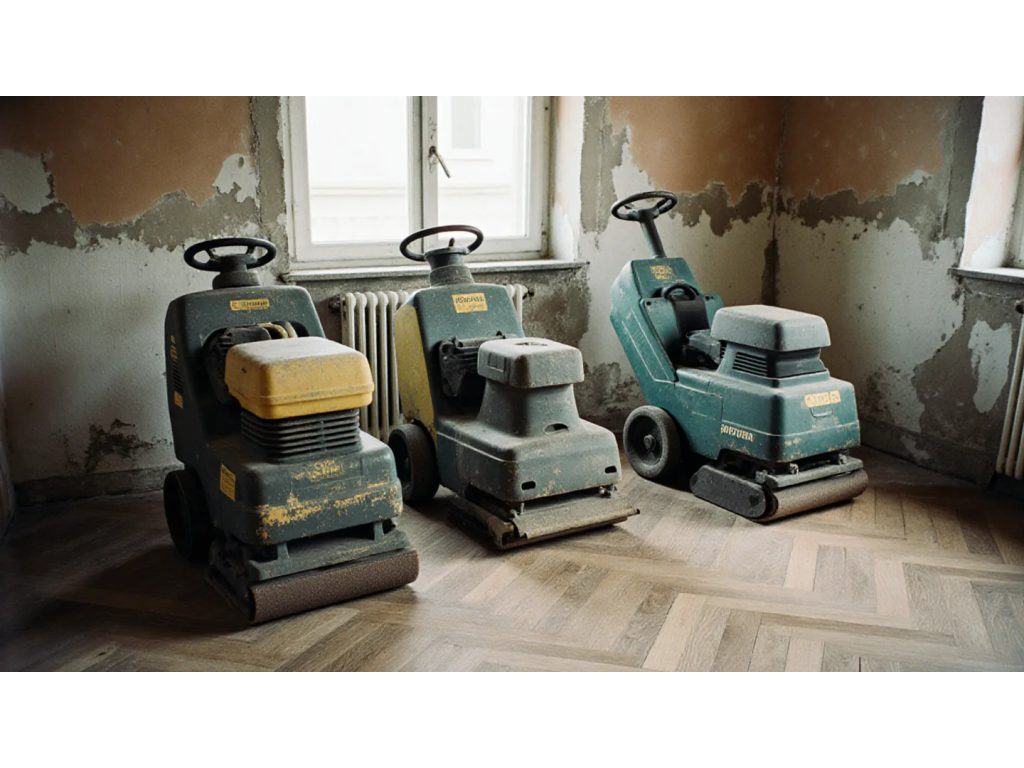
Three principles, three families
A belt sander turns a drum fitted with an endless abrasive belt. It removes a lot of material and works along the direction of the boards. It is the machine for the first cut.
A single disc machine turns a single backing pad at low speed. It does not dig in, it levels and it polishes. It is also the maintenance machine, the one that washes, strips and buffs.
A planetary disc sander turns several small backing pads inside a large plate that itself rotates. Two superimposed rotations, and therefore no repeated path. The catalogue draws its main argument from this: sanding “without leaving a mark”.
The belt sanders in the catalogue
| Model | Reference | Belt | Drum | Power | Drum speed | Weight |
|---|---|---|---|---|---|---|
| Arlequin | 001950 | 200 x 480 mm | Ø 150 x 200 mm | 1 300 W | 900 rpm | not specified |
| Scorpion | no reference in the database | not specified | Ø 150 x 200 mm | 1 500 W | 3 000 rpm | 45 kg |
| Aries | 001900 | 200 x 750 mm | Ø 150 x 200 mm | 2 200 W | 2 000 rpm | 60 kg |
| Taurus | 002900 | 200 x 750 mm | Ø 185 x 200 mm | 2 990 W | 1 800 rpm | 85 kg |
All are rated at 230 volts.
What the sheets say about each one, in their own words:
- Arlequin is presented as usable by non-professionals, with a redesigned dust extraction system.
- Scorpion has an automatic stop when the handle is released, and its sheet stresses its lightness and manoeuvrability.
- Aries has a patented system for automatic belt tensioning and tracking, adjustable drum pressure, a two-stage start and the ability to work right up to the skirting boards.
- Taurus is the only one with two speeds, which its sheet links to rough sanding followed by finishing. It comes apart in three pieces for transport, which matters when you carry it upstairs: 85 kg in one block will not get up a staircase.
The single disc machines
| Model | Reference | Backing pad or width | Power | Speed | Weight |
|---|---|---|---|---|---|
| SP 8 | 033080 | Ø 330 mm | 750 W | 180 rpm | not specified |
| SP 15, special wood floor equipment | P43150 | not specified | 1 500 W | 154 rpm | 43 kg |
| SP 15, all surfaces | 143150 | not specified | 2 990 W | 154 rpm | 43 kg |
| SP 22 | 143220 | not specified | 2 200 W | 154 rpm | 53 kg |
All three SP machines take an extra weight: 20 kg is entered as “additional weight” for the SP 15, and the catalogue sells a 15 kg extra weight (ref. 143020) and an 8.5 kg extra weight (ref. 144008) separately. Dust extraction is a separate module, entered at 10 kg for the SP 15 (SP 15 dust extraction system, ref. 043120).
The SP 15 with special wood floor equipment is supplied as a pack: dust extraction kit, extra weight, multi-disc backing pad, five hook and loop pads Ø 100 mm and a Ø 406 mm pin drive plate. Its sheet gives it for sanding and finishing all traditional wood floors, mosaic and herringbone, de-nibbing between coats of varnish, and waxed or oiled finishes. On hard floors, it mentions sanding levelling compound and concrete screed, and renovating marble and comblanchien stone.
The SP 8 is a maintenance floor polisher for small areas: stripping, cleaning, waxing, polishing and buffing, on wood floors, thermoplastic floors, carpets and hard floors.
The planetary disc sanders
This is the top of the range in the catalogue, and the two machines that have drawn the most enquiries over the years.
| Model | Reference | Plate | Power | Plate speed | Weight |
|---|---|---|---|---|---|
| Quadral | 044400 | 4 discs Ø 140 mm, roller Ø 450 mm | 2 200 W | 800 rpm | 53 kg bare, 75 kg with planetary head |
| Trial | 044300 | 450 mm plate and 3 discs Ø 140 mm | 3 000 W | 800 rpm at the plate, 150 rpm machine | 62 kg bare, 107 kg fully equipped |
The Quadral sheet claims that it replaces four machines: the belt sander, the single disc machine, the edge sander and the vacuum cleaner. It adds that with its large pin drive plate, it de-nibs coats of varnish, is used for oiling and waxing, and polishes.
The Trial sheet claims three machines in one (floor sanding machine, floor polisher, edge sander) and highlights its 3 000 W. It lists four jobs: sanding wood floors without leaving a mark, sanding levelling compounds, removing resins and paint from floors, and sanding concrete screeds.
Both share the same family of accessories: Ø 140 mm diamond discs, Ø 140 mm hook and loop backing pad (ref. 000684), Ø 450 pin drive plate (ref. 044407), Ø 406 mm carbide ring plate (ref. 043400), bush hammering plate (ref. 045030), 18 L tank (ref. 043018) and the extra weights.
And concrete
Three machines in the catalogue are classed as concrete grinders, with an output stated on their sheets.
| Model | Reference | Working width | Power | Stated output | Weight |
|---|---|---|---|---|---|
| Single disc | 052500 | 280 mm | value in the database to be corrected | 18 to 25 m²/h | 81 kg |
| Double disc | 050200 | 560 mm | value in the database to be corrected | 35 to 50 m²/h | 107 kg |
| Floor planer | 776200 | 200 mm | 2 200 W | not specified | 107 kg |
The planer's sheet states that it planes concrete by 3 mm per pass, and that the milling depth is set with the handwheel. The two disc grinders are given for surfacing and levelling concrete and terrazzo floors, with carbo stones or diamond segments.
The Concrete versions of the Trial complete the family: Trial Concrete (ref. 044303, 3 000 W, planetary head with 3 discs Ø 140) and Trial Light Concret (ref. 044403, 2 200 W, 450 mm planetary head and 4 discs Ø 140).
What this guide does not settle
It does not say which machine to buy. The choice depends on the area you treat each year, access to your sites, the type of wood floors, and what you already own. A machine that sits in the depot costs more than a hired one. Describe your situation and the answer arrives within 24 working hours, or call 03 87 71 37 50.